Monday, December 5, 2011

Stereotype and the ethics of representation

In Howard Cruses Stuck Rubber Baby, we are thrown into the world of a man who was raised with prejudice and is also struggling with his own homosexual feelings that cast him away from acceptable society.
The main focus of this comic is to show the effects of social prejudice by putting someone in the situation of being hated for who they are, when they do it to someone else as well.
This theme translates well to me with the aid of the heavy cross hatching in the illustration. Though this was created in the 90s when I feel like this was more popular (and brings back memories of posters in my elementary classrooms) I believe the thick weight to each shadow brings about a sense of uncertainly which matches the storyline and mood. Looking at the panel dense pages make me feel somewhat depressed and frustrated; I can really get the sense that ideas don't flow as well as I have seen in other books.
I would also like to point out how although this book puts a lot of emphasis on race and gender, there is not too much of an emphasis on racial features, like there are in other books. I noticed that white characters were drawn with larger lips and flatter noses, and everyone seemed to have sort of a buff metro stance.
I really enjoyed this subtle equality. I felt like it was easier to relate to each situation by giving a sense of balance; yet not too much emphasis was placed on "evening it all out."

Sunday, October 16, 2011

Maus

Reading Maus was somewhat difficult in the beginning, and it wasn't because of the actual story line or content. That actually was what kept me hooked and reading; it was the illustration I found dislike in.
I read it right after I read Blankets, and I think that has a lot to do with that. In comparison to Craig Thompsons smooth transitions and decisive lines, Maus was very harsh and repetitive. Each frame seemed to repeat to me, and I felt great difficulty in holding my eyes ground in what I was reading. After some time into the novel, my problem with the illustration ended up turning to be quite beneficial. Certain visual notions became more apparent among the over saturation of repetitive frames.
The idea of the authors personal connection also kept me addicted. The way the story telling is set up; with the translation from one person through the next (parents > author) was interesting. I felt like the idea of the phrase "lost in translation" wasn't shunned. the possibility of things becoming somewhat skewed was real, and I enjoyed it for that idea.
The importance of memories is stressed, and I feel like this is used to relate to our own experiences. Because we are learning the story through someone who is experiencing it being told, we can relate to how certain experiences in our life are important and how they relate to our relationships with close family members and friends.

Underground Comics

The allure of underground comics is very understanding. During their development, they represented the ever important evolutionary process of generational liberation in parts of the 60's and 70's.
These have been some of my favorite selections so far. I found the explicit and over the top subject matter interesting for the fact that these were completely rooted in reality.
Being someone who didn't live through these time periods, my perceptions of the way the specific stereotypical lived then has been fed to me form pop culture references from movies and historical images.
This is why these comics are so interesting; they are coming form the source. I mean, I'm not going to lie, it is very over the top, and I sometimes struggled with what amount of people were actually like this. Well, its more of the question of to what degree was the average intensity of it, and how different was it experiencing this without the internet broadcasting it? I feel like there was a lot more emphasis on actually experiencing things, so these comics were a way to communicate that we were all in the same boat.

I really though enjoyed the honesty in some of the shroom trip scenes through the comparison of what the trip experience was, to what the person looks like in real life. I admire this humor, and it gives me insight to the perceptions of the way this counter culture viewed themselves.
I liked the extreme probability of these trip scenes being inspired by real ones as well.

Tales from the Crypt

These comic books were incredibly interesting to me because of the relationship to their age with their novelty of today.
These books make me think classic comic books. They fit the stereotype of horror related, high half toned print, bright color blocking, and the infamous monster with beautiful helpless woman.
But what really intrigued me was how the illustrations can stay so intense for so long, yet still be effective without becoming tiring. Reading panels kept me in a sense of restlessness; every social interaction and movement, no matter now small, was drawn out with bright colors and heavy lines.
It also interests me how these first comic books were so much more acceptable then as a form of entertainment then how they are now. By saying that I note that I am trying to exclude the common knowledge that newer generations don't prefer print or reading.
I am talking more about the genre; the core idea of what these comics represented that I feel is lost now. I think the idea of entertainment and imagination had a completely different structure then. Now we are so overly saturated with complex super heroes and special effects that we have become jaded.
There was a sense of satisfaction reading these comic books that brought me down to why I consider things entertaining and spooky. I will always wonder what it was like to read these books when they were considered modern; the novelty of the oldness always messes with my head. To process these books without modern day over saturation would change the experience completely.

Little Nemo

First of all, I loved that Little Nemo finally came into public domain, and that I was able to see them all lined up chronologically online with large thumbnails. I found it so interesting, especially for a comic that was so much a pioneer in its field, to be viewed as groupings in order. You are totally able to see the evolution of the strip; and especially when certain setups become popular and others die out. For example, sometimes the complexity changed from month to month. There were some with very minimal transitions; these even had characters blending into frames. The idea of time was blurred and so were the dissection of moments. But then we had certain times that were boxed out and set apart.
It was just really fun looking at this from the illustrators perspective; especially when you must make one every week.

Another thing I enjoyed was the varying complexity in how Nemo woke up from Slumberland. I understand that it was almost slapstick at times, but there were many instances that it really felt all to real and very adult. The certain situations and meanings seemed blunt and rivaled hardships we have; I felt like his awakening was a parallel to how we react to negativity at times. I also found his way of rationalizing how he woke up to be intriguing. The little words and sentences he mutters to himself played along with these themes.

Understanding Comics


This was rather enjoyable because of the novelty of reading a book about its own genre. Understanding Comics is a graphic novel about, well, graphic novels. This bluntness made for a clear analyzation of the whole medium.
The whole book is a breakdown of the subject matter, and its ability to be quite frank with its examples is what brings the tricks of the trade of comics into light.
When I first started reading, I thought that there would be a lot about the obvious ways we perceive comics. Meaning I expected a lot about how we physically view and move through each strip. While there was much about that, as well as the drawings themselves, I found there to be many more in-depth specifics involved.

There were a lot of things about generes and stereotypes. It became clear that the idea of comics are not about what you see, but its about what you don't see. Each strip (specific to each author) is made by what is not there. The power is in the space between each frame - the ideas and feelings you have to fill in on your own.

I do realize that this is the same with text only novels. The difference I see in the two mediums is that comics give you a baseline - a guideline if you will - into how the author saw it for himself/herself. Because of this visual imagery you get something more, especially when it comes to something so stylized as illustration. It has become apparent to me how well this translation works. I forget I am even looking at an image at most times.
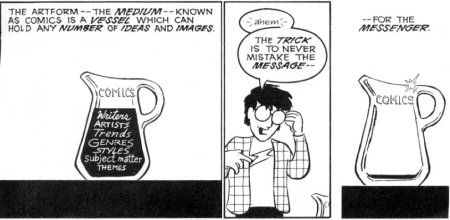
This panel in Understanding Comics sums this idea up:

Tuesday, September 20, 2011

Blankets by Craig Thompson

This particular graphic novel is one that I have always been trying to find an excuse to buy. It was somewhat pricey, but once you pick up the physical copy you realize why. This 600 page monster of a book is filled with outstanding illustrations and phrases describing ones journey into self assurance. Craig is such a relatable character and you feel like you are right in his mind as the book progresses.

I really related to the character because I experienced something similar growing up. Though I wasn't raised completely hardcore Baptist like Craig was, I grew up Catholic and took it very seriously, mostly because I was told that it was real by my parents and adults at church. And why wouldn't I believe something my parents/adults in my life told me? After all, they are there to teach you. They're older, and to a little kid, they're always right.
I remember being so scared of sin; there was this one point that remember thinking I was going to Hell and crying to my mom. Growing older, sexuality was also terrifying. I didn't think of it as a beautiful human emotion, instead I was scared of it.
Craig seemed to experience the same struggles of taking religion/authority seriously. He was a very socially shy guy and his lust for Raina and his dedication to God seemed like they would never coexist. Each time they get closer he feels guilty and suppresses his desire for her.
Eventually he starts to get older and question what God actually was. After pushing the boundaries and finally letting loose he realizes that God wants him to enjoy his life and finally experiences being with Raina.
Some of the illustrations became so human to me; the power of guilt and fear of sin seem very blatant in some panels. The ones of Craig experiencing beautiful things that he felt he could not touch had so much built up emotion in each mark.
I really admired the attention to the female body as well. It was obvious that Craig was struggling with sexuality being a sin, but the way Rainas body was illustrated created a sense of righteousness in what he was experiencing. Instead of it being something dirty the illustrations create her body to be something very natural and beautiful.
The books ability to transform sin into something beautiful and natural, as well as a humans discovery of this thought process, really makes this book what it is.